Method
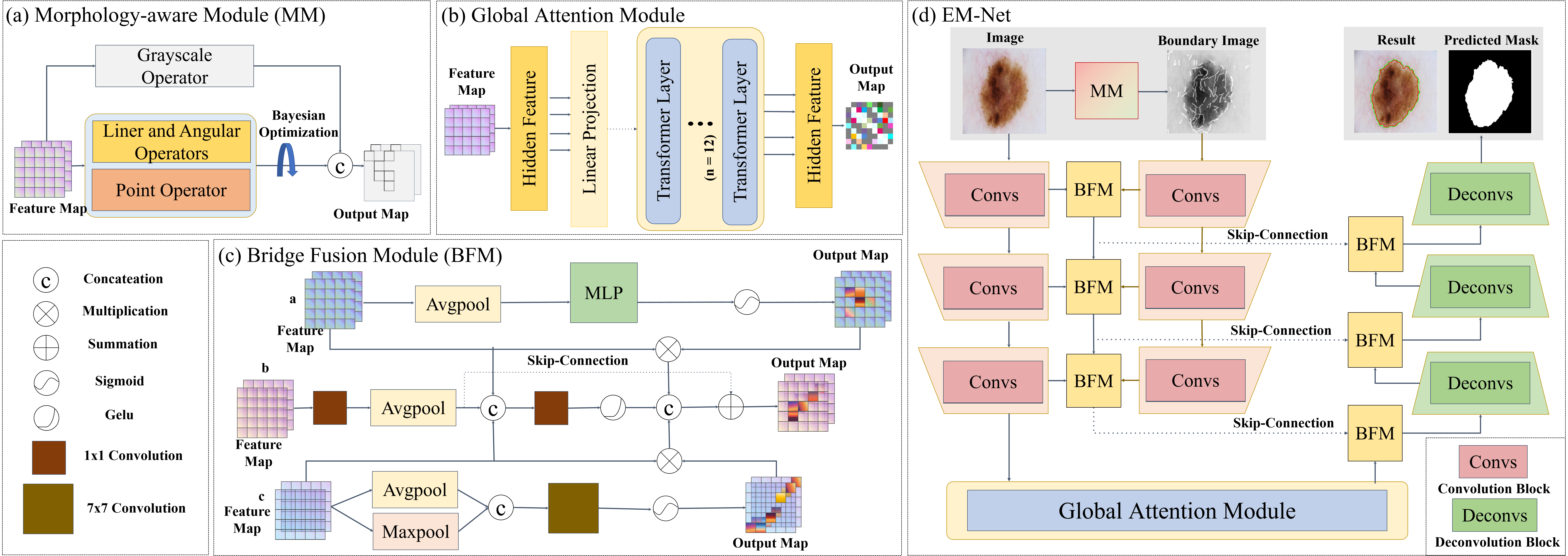
Overall architecture of the proposed EM-Net.
Dermoscopic images are essential for diagnosing various skin diseases, as they enable physicians to observe subepidermal structures, dermal papillae, and deeper tissues otherwise invisible to the naked eye. However, segmenting lesions in these images is challenging due to their irregular boundaries and significant variability in lesion characteristics. To address these challenges, we propose a effective and morphology-aware network that utilizes a hybrid feature extractor combining CNN and ViT architectures. At the same time, we enhanced the proposed segmentation model. Specifically, we propose a boundary delineation component that uses a non-convex optimization function for learning general representations and accurately delineates lesion boundaries, thus enhancing the extraction of details. Additionally, we also introduce an adaptive segmentation strategy through the integration of the few-shot domain generalization module to improve the model's generalization across different datasets. Validation on multiple publicly available dermoscopic image datasets, including ISIC, PH², PAD-UFES-20, and the University of Waterloo skin cancer database, demonstrates that our method achieves state-of-the-art performance with significant improvements in Dice, Acc, Pre, IoU, and Re. These results confirm the robustness and adaptability of our model. The code is available at: https://github.com/Bean-Young/EM-Net.
Overall architecture of the proposed EM-Net.
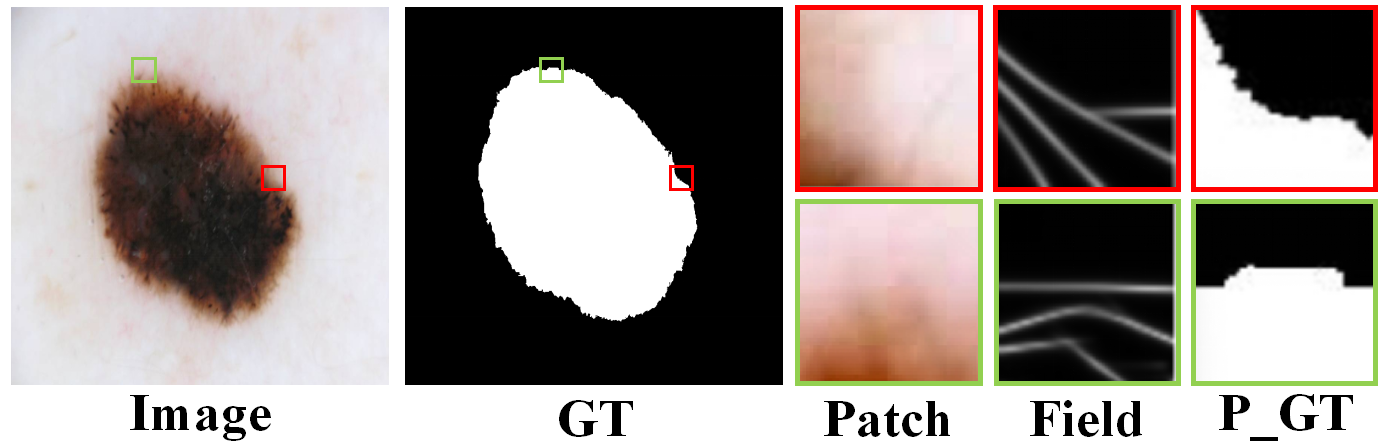
Illustration of morphology-aware boundary capture.
| Method | test-ISIC 2016 | test-ISIC 2017 | validation-ISIC 2018 | ||||||||||||
|---|---|---|---|---|---|---|---|---|---|---|---|---|---|---|---|
| Dice | IoU | Acc | Pre | Re | Dice | IoU | Acc | Pre | Re | Dice | IoU | Acc | Pre | Re | |
| U-Net | 90.29 | 82.58 | 94.76 | 91.29 | 87.72 | 82.80 | 73.30 | 92.30 | 89.07 | 79.30 | 88.43 | 79.71 | 93.16 | 89.46 | 85.89 |
| Att-UNet | 90.83 | 83.43 | 94.43 | 92.12 | 88.42 | 83.20 | 74.40 | 92.50 | 87.29 | 84.11 | 88.32 | 79.52 | 93.17 | 87.73 | 87.11 |
| CE-Net | 91.80 | 85.01 | 95.30 | 91.84 | 90.32 | 85.61 | 77.54 | 93.51 | 89.91 | 84.52 | 89.45 | 81.32 | 94.03 | 89.18 | 87.60 |
| CPF-Net | 91.34 | 84.24 | 95.18 | 91.34 | 89.78 | 84.70 | 76.20 | 93.00 | 86.67 | 83.33 | 88.86 | 80.45 | 94.68 | 88.44 | 87.57 |
| MS RED | 91.43 | 84.43 | 95.67 | 91.60 | 89.53 | 84.83 | 76.32 | 93.10 | 87.07 | 83.74 | 89.18 | 80.92 | 95.03 | 89.14 | 87.36 |
| FAT-Net | 91.49 | 84.49 | 96.07 | 91.11 | 90.41 | 85.01 | 76.92 | 93.64 | 87.77 | 84.52 | 89.18 | 80.92 | 95.18 | 88.52 | 87.88 |
| TransUNet | 91.32 | 84.89 | 96.21 | 92.28 | 89.63 | 85.51 | 77.34 | 93.47 | 88.56 | 84.22 | 89.50 | 82.61 | 93.67 | 88.12 | 89.50 |
| Swin-UNet | 91.27 | 84.14 | 96.18 | 91.39 | 89.45 | 83.50 | 72.28 | 93.20 | 84.27 | 83.14 | 88.46 | 79.86 | 94.45 | 88.24 | 87.43 |
| Ours | 91.89 | 85.57 | 96.25 | 95.65 | 89.66 | 86.42 | 78.37 | 93.97 | 92.17 | 85.33 | 91.47 | 84.78 | 95.35 | 91.28 | 93.15 |
Comparison with alternative approaches on ISIC datasets.
| Method | test-ISIC 2018 | ||||
|---|---|---|---|---|---|
| Dice | IoU | Acc | Se | Sp | |
| SCDC | 88.50 | 82.40 | 92.90 | 95.30 | 91.10 |
| ACA-Net | 89.10 | 81.90 | - | 94.30 | 93.20 |
| Deeplabv3+ | 89.60 | 82.50 | 94.20 | 96.20 | 92.10 |
| SESV-DLab | 90.20 | 83.30 | 94.60 | 96.20 | 92.50 |
| ICL-Net | 90.30 | 83.90 | 94.40 | 94.10 | 92.90 |
| Ours | 90.30 | 83.60 | 94.70 | 92.40 | 93.90 |
Comparison on the ISIC 2018 Challenge ranking list.
| Method | test-PH² | ||||
|---|---|---|---|---|---|
| Dice | IoU | Acc | Pre | Re | |
| U-Net | 90.56 | 83.56 | 94.86 | 90.30 | 93.47 |
| Att-UNet | 90.29 | 82.70 | 94.68 | 91.35 | 93.26 |
| CE-Net | 90.87 | 83.90 | 95.38 | 93.21 | 96.01 |
| CPF-Net | 91.67 | 85.48 | 95.59 | 91.81 | 95.90 |
| MS RED | 92.65 | 85.29 | 95.46 | 90.38 | 95.52 |
| FAT-Net | 92.21 | 85.18 | 95.43 | 92.85 | 96.33 |
| TransUNet | 90.96 | 83.99 | 95.42 | 91.18 | 95.68 |
| Swin-UNet | 92.69 | 87.08 | 96.03 | 91.42 | 94.87 |
| ICL-Net | 92.80 | 87.25 | 96.32 | - | 95.46 |
| Ours | 94.03 | 88.92 | 96.34 | 94.06 | 94.57 |
Quantitative evaluation on the PH² dataset.
| Method | test-Waterloo | test-PAD | ||||||||
|---|---|---|---|---|---|---|---|---|---|---|
| Dice | IoU | Acc | Pre | Re | Dice | IoU | Acc | Pre | Re | |
| U-Net | 82.71 | 72.41 | 96.03 | 74.78 | 96.47 | 87.71 | 79.45 | 94.85 | 82.47 | 95.69 |
| TransUNet | 86.51 | 77.21 | 97.68 | 80.12 | 96.49 | 90.82 | 83.80 | 96.98 | 90.76 | 92.06 |
| Ours | 90.03 | 82.47 | 98.42 | 94.69 | 87.14 | 91.88 | 85.37 | 97.41 | 95.69 | 89.02 |
Comparison on datasets imaged by mobile phones.
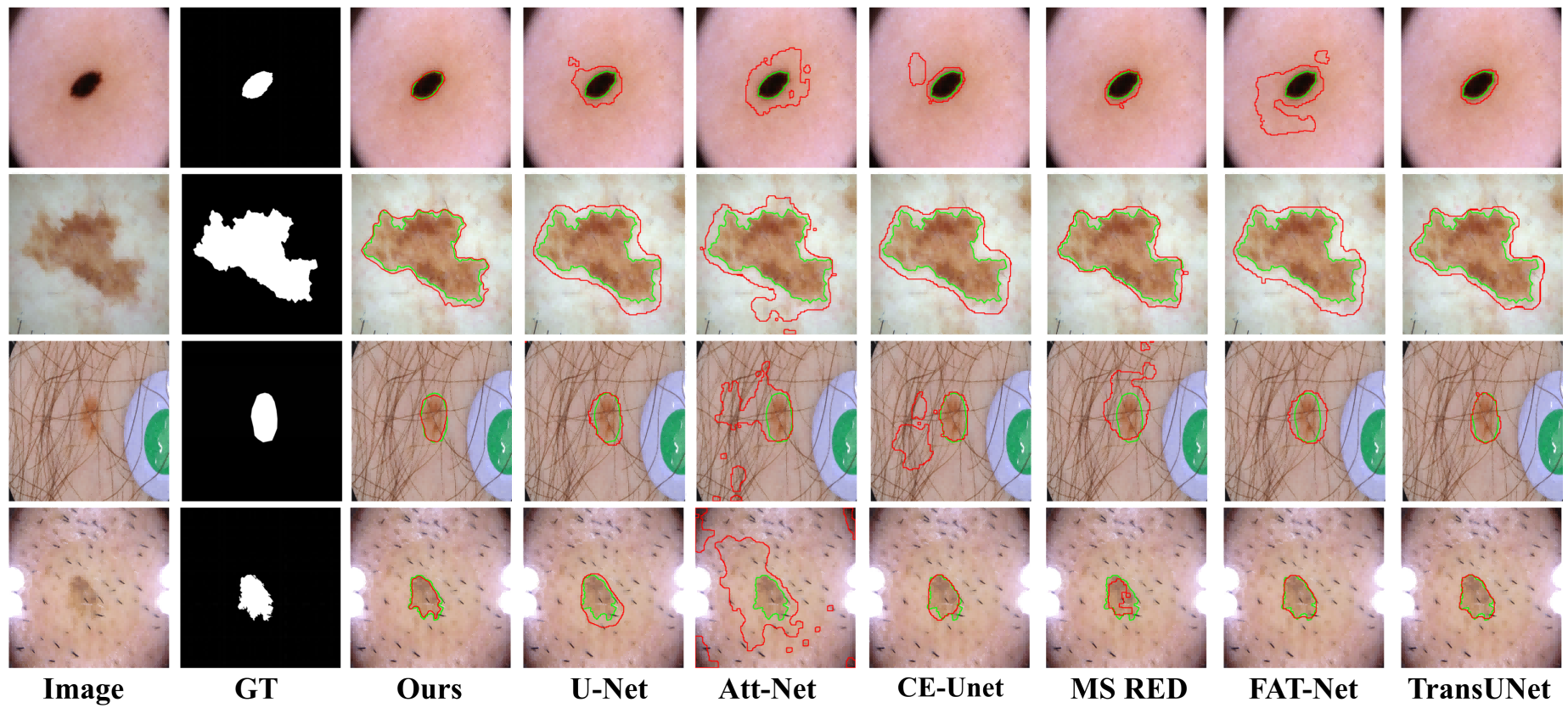
Visual comparison on the ISIC dataset.
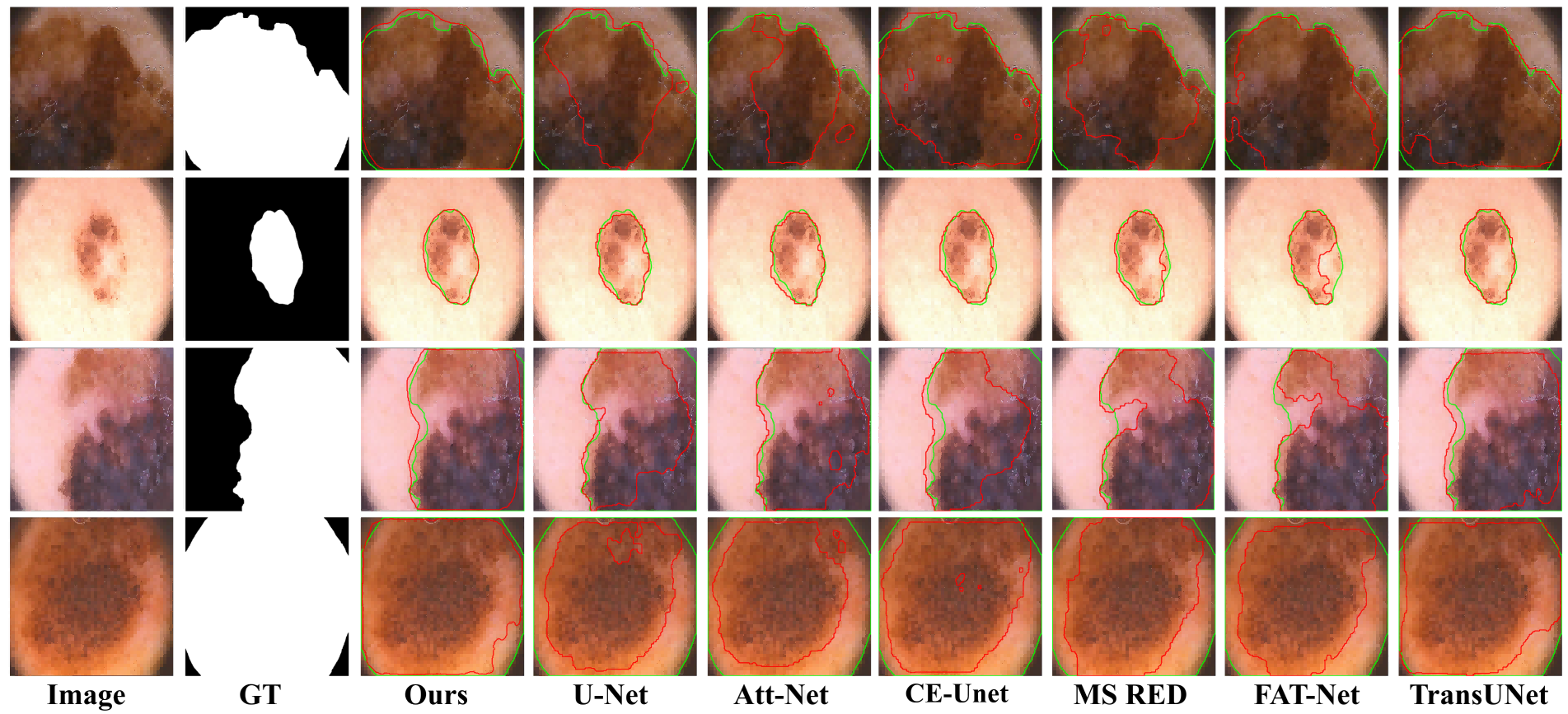
Visual comparison on ISIC 2016 and PH² datasets.
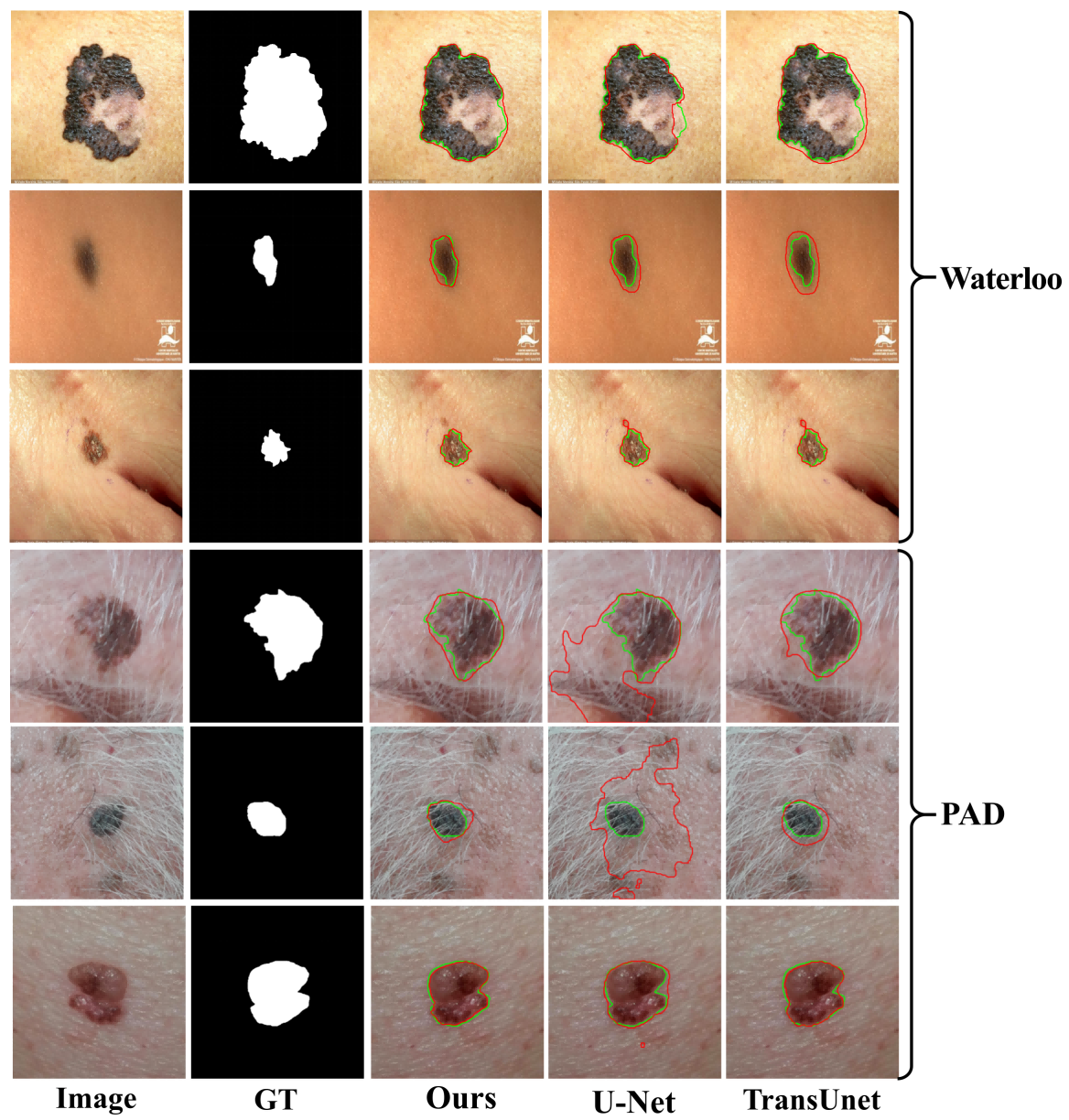
Visual comparison on mobile-phone dermoscopic images.
@article{zhu2025net,
  title={EM-Net: Effective and morphology-aware network for skin lesion segmentation},
  author={Zhu, Kaiwen and Yang, Yuezhe and Chen, Yonglin and Feng, Ruixi and Chen, Dongping and Fan, Bingzhi and Liu, Nan and Li, Ying and Wang, Xuewen},
  journal={Expert Systems with Applications},
  pages={127668},
  year={2025},
  publisher={Elsevier}
}