Method
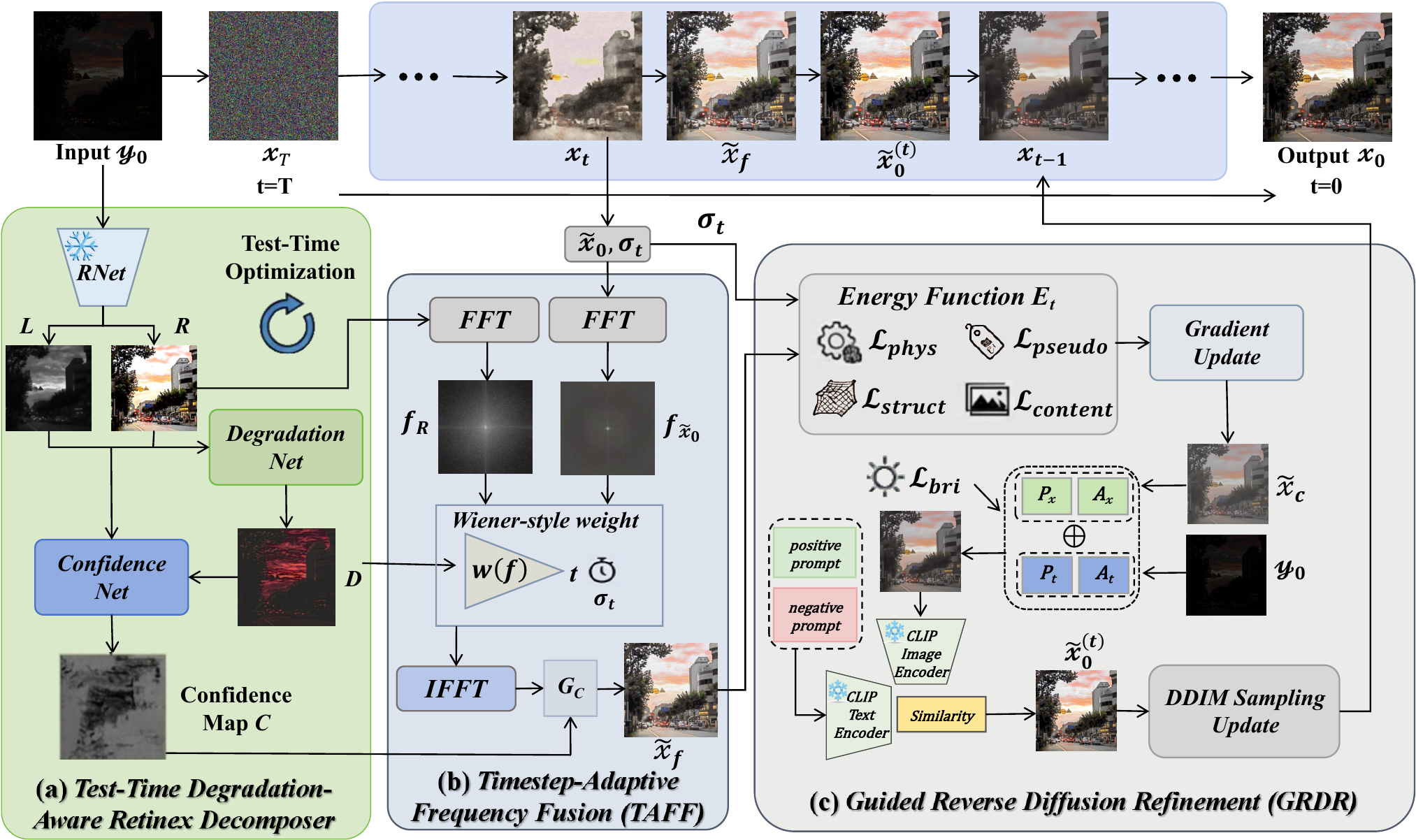
Overview of the test-time decomposer, timestep-adaptive frequency fusion, and guided reverse diffusion refinement.
Existing diffusion-based low-light image enhancement methods often require paired training data or lack reliable scene constraints in zero-shot settings, leading to structural inconsistencies and color drift. We present DARD, a zero-shot degradation-aware Retinex-guided diffusion framework. DARD extracts image-specific physical priors with test-time Retinex decomposition, combines them with diffusion predictions using timestep-adaptive frequency fusion, and refines the reverse process with physical-consistency and CLIP-based semantic guidance. Evaluations on real-world low-light benchmarks show strong restoration performance. Enhanced images also improve downstream semantic segmentation, including a 28.10% relative mIoU gain over AGLLDiff on LOLv1.
Overview of the test-time decomposer, timestep-adaptive frequency fusion, and guided reverse diffusion refinement.
| Method | LOLv1 | LOLv2-real | ||||
|---|---|---|---|---|---|---|
| PSNR | SSIM | LPIPS | PSNR | SSIM | LPIPS | |
| AGLLDiff | 19.83 | 0.814 | 0.194 | 19.99 | 0.844 | 0.192 |
| DARD | 21.14 | 0.835 | 0.143 | 22.18 | 0.877 | 0.135 |
Zero-shot low-light enhancement comparison on LOLv1 and LOLv2-real.
| Dataset | SegFormer + AGLLDiff mIoU | SegFormer + DARD mIoU | Relative improvement |
|---|---|---|---|
| LOLv1 | 21.32 | 27.31 | +28.10% |
| LOLv2-real | 28.09 | 35.13 | +25.06% |
Downstream semantic segmentation using enhanced images.
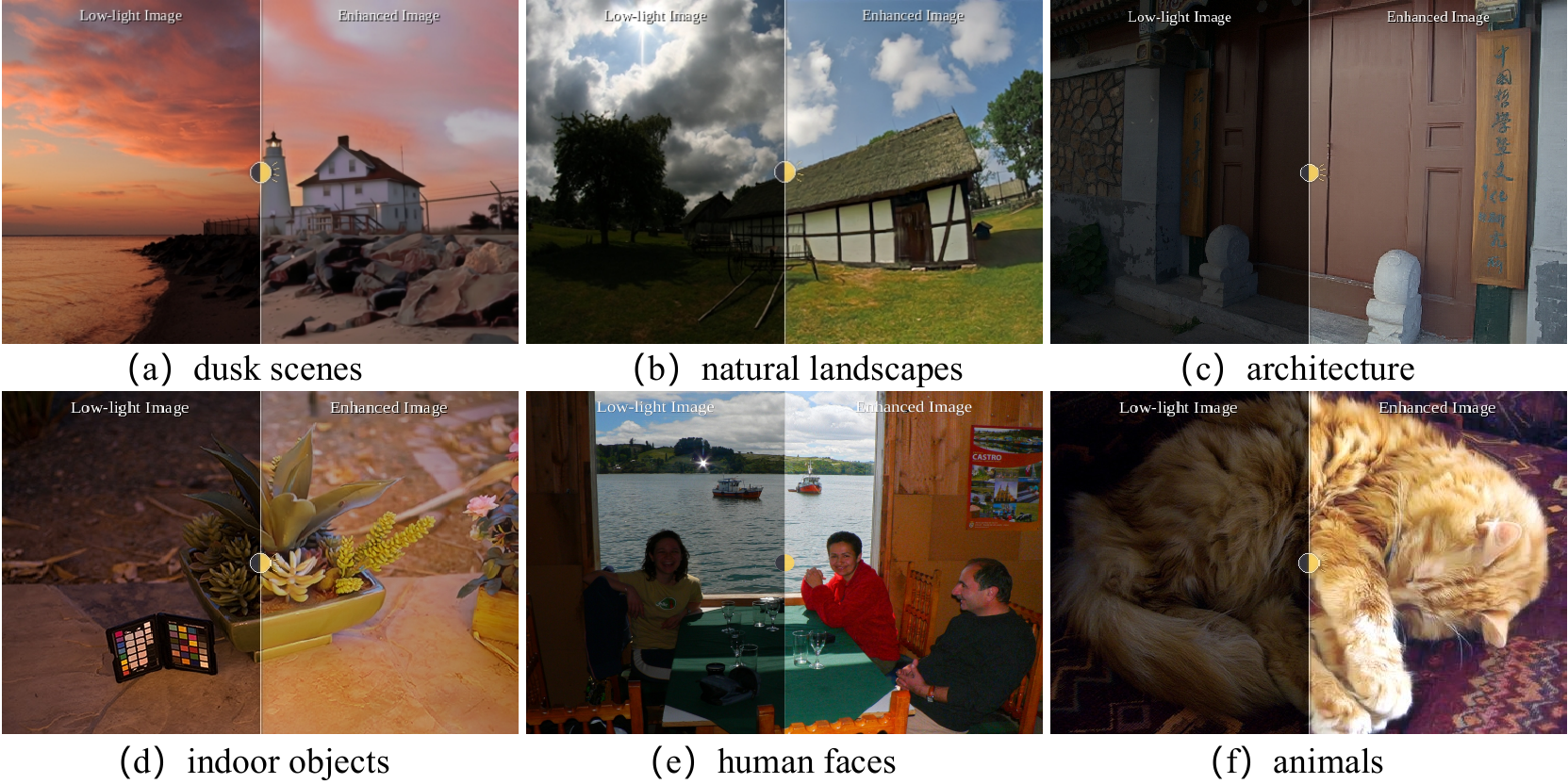
Representative enhancement results across real-world low-light scenes.
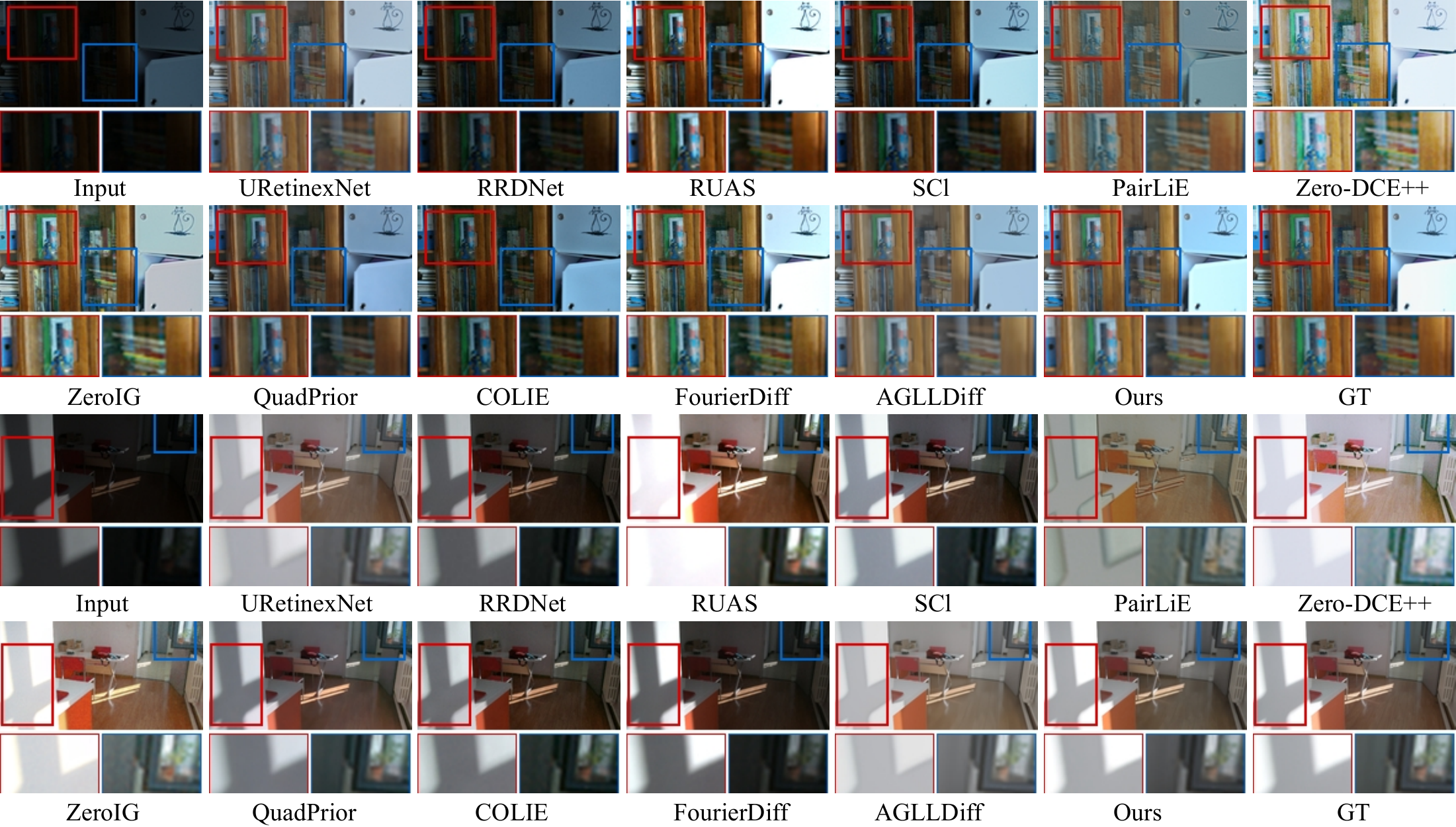
Visual comparison on the LOLv1 and LOLv2-real datasets.
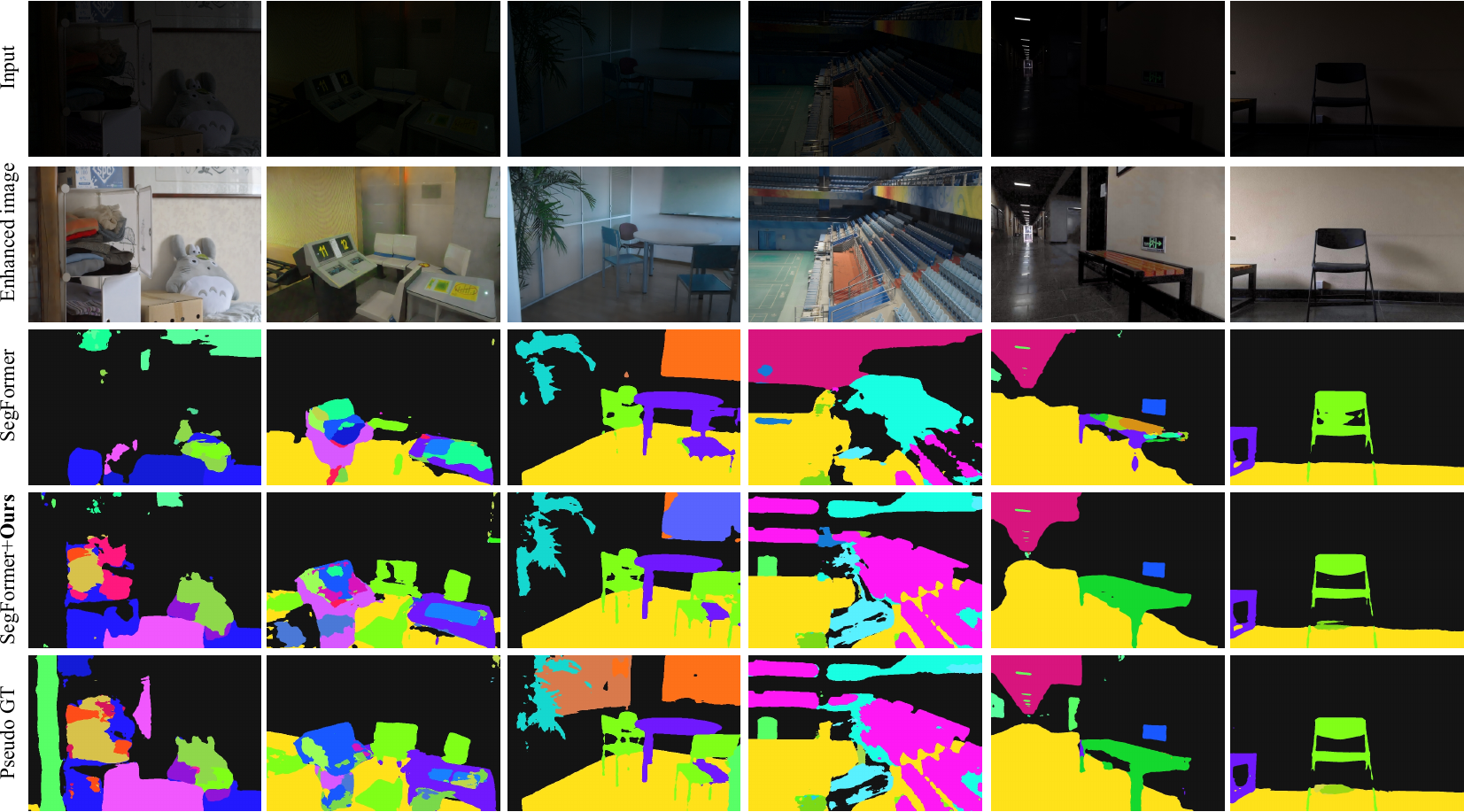
Semantic segmentation results on low-light scenes.
@article{cai2026dard,
  title={DARD: Zero-Shot Degradation-Aware Retinex-Guided Diffusion for Low-Light Image Enhancement},
  author={Cai, Wenjie and Yang, Yuezhe and Xia, Jianyang and Dong, Xingbo and Jin, Zhe},
  journal={IEEE Transactions on Circuits and Systems for Video Technology},
  year={2026},
  url={https://ieeexplore.ieee.org/abstract/document/11701592}
}